10 Signs Your Dog Needs a Vet Immediately: A Veterinarian's Guide for UAE Pet Parents
By Dr. Elizabeth Thomas | Founder & Chief Veterinary Officer, Pets Oasis | Veterinarian with over 30 years of experience
As a veterinarian with more than 30 years of clinical experience, I have seen countless situations where a pet parent's decision to seek veterinary attention at the right time made all the difference.
Sometimes, the warning signs are unmistakable. A dog collapses, struggles to breathe, or experiences a seizure.
But at other times, the symptoms are surprisingly ordinary.
A dog stops eating. Vomits repeatedly. Develops diarrhoea that does not improve. Or simply behaves differently.
And this is where recognising the early warning signs becomes so important.
One of the questions pet parents frequently ask me is:
"How do I know whether my dog really needs to see a veterinarian, or whether I can wait and see?"
It is an important question because not every symptom is an emergency, but some symptoms should never be ignored.
In this article, I want to share ten warning signs every dog parent should recognise, drawing on my years of veterinary practice and the clinical cases we encounter at Pets Oasis Veterinary Clinic in Umm Al Quwain.
My goal is simple: to help you recognise when your dog needs veterinary attention before a manageable problem becomes a life-threatening emergency.
1. Difficulty Breathing or Unusual Breathing Patterns
Breathing difficulties are among the most serious warning signs in dogs.
A healthy dog may pant after exercise, during excitement, or when trying to cool down. However, there is a difference between normal panting and respiratory distress.
Warning signs to watch for
- Rapid or laboured breathing while resting
- Open-mouth breathing accompanied by obvious distress
- Excessive effort to inhale or exhale
- Blue, grey, or unusually pale gums
- Stretching the neck forward to breathe
- Weakness or collapse associated with breathing difficulty
What could be wrong?
Breathing difficulties can occur with heart disease, respiratory infections, airway obstruction, fluid accumulation in or around the lungs, allergic reactions, or heatstroke.
What should you do?
Difficulty breathing is an emergency. Seek veterinary care immediately.
Keep your dog calm, minimise unnecessary handling, and avoid forcing food or water. If possible, telephone the veterinary clinic while travelling so the team can prepare for your arrival.
2. Repeated Vomiting or Severe or Persistent Diarrhoea
Vomiting and diarrhoea are among the most common reasons dogs visit veterinary clinics.
A single mild episode does not always indicate a serious problem, particularly if your dog remains bright, comfortable, and otherwise normal.
However, repeated vomiting, severe diarrhoea, or gastrointestinal symptoms that continue despite treatment deserve prompt attention.
Warning signs to watch for
- Repeated vomiting over a short period
- Vomiting accompanied by lethargy or abdominal pain
- Inability to keep water down
- Bloody vomit or diarrhoea
- Frequent watery diarrhoea
- Persistent or recurrent diarrhoea that does not improve
- Vomiting or diarrhoea accompanied by loss of appetite
What could be wrong?
Possible causes include dietary indiscretion, intestinal parasites, infections, pancreatitis, toxin exposure, inflammatory gastrointestinal conditions, or foreign-body ingestion.
Importantly, similar symptoms can arise from very different conditions.
That is why identifying the underlying cause matters.
From Dr. Elizabeth's Clinical Practice: When Persistent Diarrhoea Revealed a Hidden Danger
Recently, a six-year-old Golden Retriever was brought to us at Pets Oasis with recurrent diarrhoea that was not responding to antidiarrhoeal treatment.
Diarrhoea is one of the most common gastrointestinal complaints we encounter in veterinary practice. In many cases, the cause is relatively straightforward.
But when symptoms persist despite treatment, we must ask an important question:
Are we treating the symptom while missing something more serious?
We decided to investigate further.
Abdominal X-rays and ultrasound revealed something unexpected: a stone inside the dog's stomach.
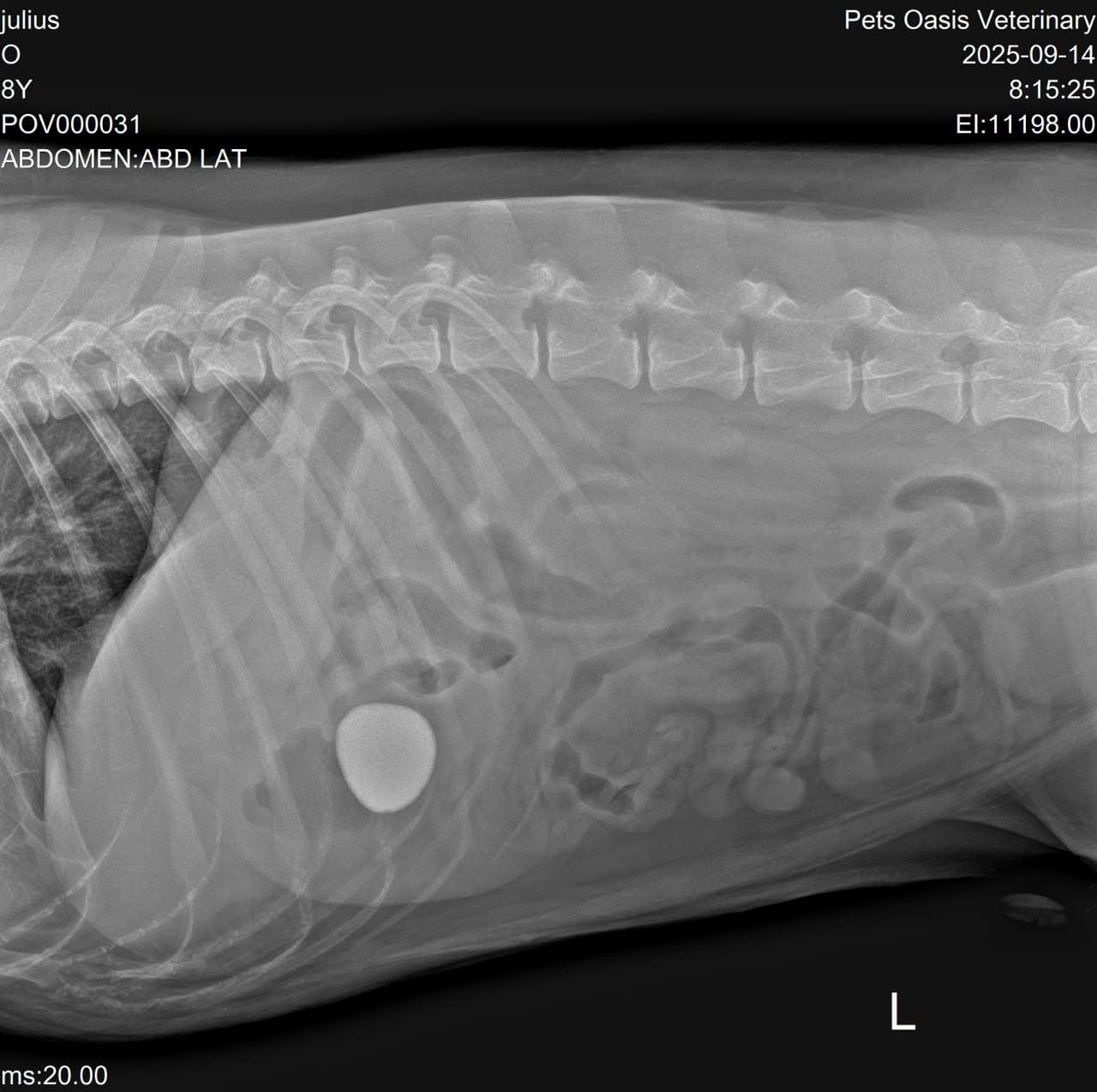
The stone was a gastric foreign body discovered during our investigation of the persistent diarrhoea.
Based on our clinical assessment, we proceeded with immediate surgery to remove it.
The surgery was successful, and timely intervention saved the dog's life.
Foreign bodies in the stomach can cause irritation and potentially serious complications. Some may pass into the intestines and cause obstruction, while others remain in the stomach. Their clinical significance depends on factors such as their size, shape, location, and the dog's condition.
We cannot assume that every gastric foreign body causes diarrhoea. However, this case demonstrates why persistent symptoms warrant further investigation, particularly when the expected response to treatment does not occur.
After more than 30 years in veterinary practice, cases like this continue to reinforce one of my most important beliefs:
"When symptoms persist despite treatment, we must look beyond the symptoms and search for the underlying cause."
For pet parents, the message is simple.
Persistent or recurrent diarrhoea should never be ignored, especially when it does not improve with treatment.
Sometimes, another medication is not the answer.
Sometimes, the answer lies in asking the right questions, performing the right investigations, and acting before serious complications develop.
Early investigation can reveal what symptoms alone cannot tell us.
What should you do?
Seek immediate veterinary attention if vomiting or diarrhoea is accompanied by collapse, severe weakness, significant abdominal pain, blood loss, or an inability to keep water down.
Contact your veterinarian promptly if diarrhoea is persistent, recurrent, or not responding to treatment.
Do not repeatedly administer antidiarrhoeal or human medications without veterinary guidance.
3. Sudden Collapse, Extreme Weakness or Loss of Consciousness
A dog that suddenly collapses requires immediate veterinary attention.
Collapse may occur because of problems affecting circulation, the heart, nervous system, metabolism, or other vital functions.
Warning signs to watch for
- Sudden inability to stand
- Loss of consciousness
- Extreme weakness
- Staggering or falling repeatedly
- Unresponsiveness
- Collapse during or after exercise
What could be wrong?
Possible causes include heart rhythm abnormalities, internal bleeding, severe dehydration, heatstroke, poisoning, low blood sugar, or neurological disease.
What should you do?
Treat sudden collapse as an emergency, even if your dog appears to recover.
Keep your dog safe and as still as possible while arranging immediate veterinary care. Avoid offering food or water to an unconscious or poorly responsive animal.
4. Refusing Food or Water, Especially with Other Symptoms
Dogs occasionally eat less because of stress, environmental changes, or minor digestive disturbances.
However, a sudden loss of appetite can also be an early indication of illness.
Warning signs to watch for
- Complete refusal of food
- Reduced or absent water intake
- Loss of appetite accompanied by vomiting
- Refusal to eat with lethargy or pain
- Difficulty chewing or swallowing
- Sudden changes in drinking habits
What could be wrong?
Dental disease, gastrointestinal disorders, infections, kidney disease, liver disease, pain, and many other conditions can affect appetite.
What should you do?
A healthy adult dog that skips one meal but remains bright and otherwise normal may not need emergency care.
However, seek prompt veterinary advice when appetite loss is persistent or accompanied by other symptoms.
Puppies, very small dogs, senior dogs, and dogs with existing medical conditions may need assessment sooner. Inability to swallow, severe weakness, or signs of dehydration require urgent attention.
5. A Swollen Abdomen or Repeated Attempts to Vomit Without Producing Anything
This is one of the warning signs I particularly want large-breed dog owners to recognise.
A dog with a suddenly enlarged or painful abdomen, particularly when repeatedly trying to vomit without producing anything, may be experiencing gastric dilatation-volvulus (GDV).
GDV occurs when the stomach becomes distended and twists, interfering with circulation and normal stomach function.
It is a life-threatening emergency.
Warning signs to watch for
- Sudden abdominal enlargement
- Repeated unproductive retching
- Restlessness or pacing
- Excessive salivation
- Signs of abdominal pain
- Rapid breathing
- Weakness or collapse
Large, deep-chested dogs are at increased risk, although GDV can occur in other dogs.
What should you do?
Go to an emergency veterinary facility immediately. Do not wait for the symptoms to improve.
Do not attempt home remedies or induce vomiting.
Early emergency treatment is essential.
6. Seizures, Sudden Disorientation or Loss of Coordination
Watching a dog experience a seizure can be frightening.
Seizures may involve involuntary muscle movements, collapse, paddling of the limbs, loss of awareness, or abnormal behaviour.
Other neurological emergencies may present as sudden loss of balance, weakness, or disorientation.
Warning signs to watch for
- Convulsions or uncontrolled muscle movements
- Sudden collapse with abnormal movements
- Repeated seizures
- Difficulty standing or walking
- Sudden head tilt with severe imbalance
- Unusual disorientation
- Loss of consciousness
What could be wrong?
Possible causes include epilepsy, toxin exposure, metabolic disorders, brain disease, or other neurological conditions.
What should you do?
During a seizure, move nearby objects away to prevent injury.
Do not restrain your dog forcefully or put your hands inside its mouth.
Time the seizure if you can do so safely.
A seizure lasting five minutes or longer, or repeated seizures without full recovery between episodes, is an immediate emergency.
A first seizure, even if brief, also warrants prompt veterinary assessment.
7. Difficulty Urinating or Inability to Pass Urine
Urinary problems can quickly become serious.
A dog that repeatedly attempts to urinate but produces little or no urine may have a urinary obstruction or another significant urinary tract problem.
Warning signs to watch for
- Repeated straining to urinate
- Producing only a few drops
- Crying or showing discomfort while urinating
- Blood in the urine
- Frequent attempts to urinate
- A painful or distended abdomen
- Complete inability to pass urine
What could be wrong?
Possible causes include urinary stones, urethral obstruction, urinary tract inflammation, or other urinary conditions.
What should you do?
If your dog is trying to urinate but cannot pass urine, seek emergency veterinary attention immediately.
A complete urinary obstruction can become life-threatening.
Do not assume repeated straining is constipation without a veterinary examination.
8. Sudden Severe Lameness, Inability to Walk or Significant Pain
Dogs cannot tell us exactly where they hurt.
They communicate pain through changes in movement, posture, behaviour, and activity.
Some dogs are particularly good at concealing discomfort, which makes recognising subtle changes important.
Warning signs to watch for
- Sudden inability to bear weight on a limb
- Crying or yelping in pain
- Reluctance to stand or move
- Dragging one or more limbs
- Sudden weakness in the hind limbs
- Visible swelling or deformity
- Severe pain when touched or moved
What could be wrong?
Possible causes include fractures, joint dislocations, ligament injuries, spinal disorders, nerve injuries, or other painful conditions.
What should you do?
A dog with severe pain, suspected fracture, paralysis, or sudden inability to walk requires immediate veterinary assessment.
Restrict unnecessary movement, especially if a spinal injury is possible.
Never administer human painkillers such as ibuprofen, diclofenac, or paracetamol unless specifically directed by a veterinarian. These medications can be dangerous or toxic to dogs.
9. Pale, Blue, Grey or Yellow Gums
Your dog's gums can provide useful clues about circulation, oxygenation, and general health.
Healthy gums are typically pink, although normal pigmentation varies between dogs.
A sudden change in gum colour can indicate a serious medical problem.
Warning signs to watch for
- Very pale or white gums
- Blue or grey gums
- Yellow gums or yellowing of the eyes
- Markedly abnormal gum colour accompanied by weakness
- Collapse or breathing difficulty
What could be wrong?
Pale gums may occur with anaemia, blood loss, or poor circulation.
Blue or grey gums may indicate inadequate oxygenation.
Yellow gums can be associated with jaundice and conditions affecting the liver, bile system, or red blood cells.
What should you do?
Sudden pale, blue or grey gums, particularly with weakness or breathing difficulty, require emergency care.
Yellow gums also need urgent veterinary assessment.
Remember that gum colour alone cannot establish a diagnosis, and naturally pigmented gums may be difficult to assess.
10. Sudden Behavioural Changes or Unusual Lethargy
One of the most valuable observations a pet parent can make is recognising when their dog is simply not behaving normally.
You know your dog better than anyone.
You know its usual enthusiasm for food, walks, play, and interaction.
When those patterns change suddenly, it may be an early sign of illness.
Warning signs to watch for
- Unusual withdrawal or hiding
- Sudden aggression or irritability
- Marked lethargy
- Restlessness or inability to settle
- Unexpected vocalisation
- Sudden confusion
- Refusal to move or participate in normal activities
What could be wrong?
Behavioural changes can be associated with pain, fever, infections, neurological disease, metabolic disorders, or other medical problems.
What should you do?
Sudden severe lethargy, confusion, or behavioural changes accompanied by weakness, breathing difficulty, seizures, or collapse require emergency assessment.
Less dramatic but persistent changes should prompt a veterinary appointment.
Never dismiss a significant change in behaviour simply because your dog is not visibly injured.
Quick Reference: When Does Your Dog Need Emergency Veterinary Care?
| Warning Sign | Recommended Action |
|---|---|
| Difficulty breathing | Emergency — seek care immediately |
| Repeated vomiting or severe diarrhoea with weakness, blood loss or dehydration | Emergency |
| Persistent diarrhoea despite treatment | Prompt veterinary reassessment |
| Sudden collapse or loss of consciousness | Emergency |
| Refusal to eat with lethargy, vomiting or other concerning symptoms | Prompt assessment; emergency if severely unwell |
| Swollen abdomen with unproductive retching | Emergency |
| Prolonged or repeated seizures | Emergency |
| Inability to pass urine | Emergency |
| Severe pain, paralysis or inability to walk | Emergency |
| Pale, blue or grey gums | Emergency |
| Sudden severe lethargy or confusion | Emergency |
This table is a general guide. If your dog's condition is rapidly worsening or you are uncertain about the severity of the symptoms, seek veterinary advice immediately.
Special Considerations for Dogs Living in the UAE
Living in the UAE presents some particular health challenges for our pets.
Over the years, I have seen how our climate, lifestyle, and environment can influence the conditions we encounter in veterinary practice.
Heatstroke and heat-related illness
High temperatures and humidity can place dogs at significant risk, particularly during outdoor activities.
Heatstroke is a medical emergency.
Warning signs can include excessive panting, weakness, vomiting, collapse, disorientation, and seizures.
If you suspect heatstroke, move your dog into a cooler environment and begin cooling with cool water while arranging emergency veterinary care. Use airflow to assist cooling where possible. Avoid ice baths and do not delay transport.
Dehydration
Vomiting, diarrhoea, inadequate water intake, and heat exposure can contribute to dehydration.
Puppies, older dogs, and dogs with underlying illnesses may be particularly vulnerable.
Parasites and infectious diseases
Ticks, fleas, intestinal parasites, and infectious diseases remain important considerations in preventive veterinary care.
Depending on the disease and the dog's circumstances, signs may include lethargy, fever, gastrointestinal symptoms, anaemia, or other changes.
Foreign-body ingestion
Dogs explore their surroundings with their mouths.
Stones, toys, fabric, bones, and other objects can sometimes be swallowed, potentially causing gastrointestinal complications.
The Golden Retriever case I shared earlier is an important reminder that foreign-body ingestion may not always be obvious from the symptoms alone.
If you know or suspect your dog has swallowed a stone or another non-food object, contact your veterinarian promptly, even if your dog appears comfortable.
What Should You Do Before Reaching the Veterinary Clinic?
When your dog develops a worrying symptom, staying organised can help the veterinary team assess the situation more efficiently.
- Call the veterinary clinic. Describe the symptoms and ask whether you should come immediately.
- Observe and record the symptoms. Note when they started, how frequently they occur, and whether they are worsening.
- Keep your dog calm and safe. Minimise unnecessary movement in cases of severe pain, collapse, or suspected injury.
- Bring relevant information. Previous medical records, current medications, recent treatments, and vaccination details can be helpful.
- Mention possible toxin or foreign-body exposure. If your dog may have swallowed an object or harmful substance, tell the veterinarian.
- Avoid giving unprescribed medications. Human medications and inappropriate home treatments can complicate the situation.
If your dog is experiencing a life-threatening emergency, do not delay leaving for veterinary care to collect information or take photographs.
Why Early Veterinary Attention Makes Such a Difference
One of the greatest challenges in veterinary medicine is that animals cannot describe their symptoms.
They cannot tell us whether the pain is sharp or dull, whether they feel nauseated, or whether something has been wrong for several days.
We rely on clinical examination, the observations of pet parents, and appropriate diagnostic investigations.
Sometimes, the findings are unexpected.
A dog presenting with persistent diarrhoea may have a gastric foreign body.
A dog that appears unusually quiet may be experiencing significant pain.
A dog that suddenly refuses food may have a condition requiring urgent treatment.
This is why I encourage pet parents to focus not only on individual symptoms but also on changes from their dog's normal behaviour and health.
Early recognition does not guarantee a particular outcome, but it can provide an opportunity to diagnose and treat serious conditions before complications develop.
Prevention Matters Just as Much as Emergency Care
Although emergencies cannot always be prevented, regular veterinary care plays an important role in protecting your dog's long-term health.
Annual wellness examinations, appropriate vaccinations, parasite prevention, dental assessments, nutritional guidance, and age-appropriate screening can help identify health concerns before they become more serious.
For puppies, senior dogs, and dogs with existing medical conditions, veterinary visits may need to be more frequent.
At Pets Oasis, our approach to veterinary care is built around an important principle:
We want to help pets stay healthy, not simply treat them when they become sick.
Preventive healthcare and timely emergency care are not separate ideas. They are both essential parts of responsible, lifelong pet care.
Frequently Asked Questions
1. How do I know if my dog needs an emergency vet?
Seek emergency veterinary care if your dog has difficulty breathing, collapses, cannot urinate, has a swollen abdomen with repeated unproductive retching, experiences prolonged or repeated seizures, or shows other signs of severe illness. Rapid deterioration, severe pain, or major trauma also warrant immediate attention.
2. Is diarrhoea in dogs always an emergency?
No. A single mild episode in an otherwise healthy, active adult dog is not necessarily an emergency. However, severe, bloody, persistent, or recurrent diarrhoea, especially when accompanied by vomiting, lethargy, abdominal pain, or dehydration, requires veterinary attention.
3. Can a dog have a foreign body in its stomach without vomiting?
Yes. Clinical signs vary depending on the object, its location, and whether it causes irritation or obstruction. Some dogs may show intermittent or nonspecific gastrointestinal symptoms, while others may initially show few obvious signs.
4. When should I worry if my dog is not eating?
Loss of appetite is more concerning when it is sudden, persistent, or accompanied by vomiting, lethargy, pain, or other symptoms. Puppies, very small dogs, and dogs with underlying medical conditions may require earlier assessment. Seek veterinary advice if your dog is unwell or refusing food.
5. Can I give my dog antidiarrhoeal medication at home?
Do not give human antidiarrhoeal medications or repeatedly treat diarrhoea without veterinary guidance. Some medications are unsuitable for dogs, and suppressing symptoms without identifying the cause may delay appropriate treatment.
6. Can an X-ray or ultrasound detect a foreign body in dogs?
Yes. Radiographs and ultrasound are commonly used to investigate suspected gastrointestinal foreign bodies. Some objects are readily visible on X-rays, while others may require ultrasound or additional imaging. No single test detects every foreign body in every situation.
7. What are the warning signs of heatstroke in dogs in the UAE?
Excessive panting, weakness, disorientation, vomiting, collapse, and seizures are important warning signs. Suspected heatstroke requires immediate cooling and emergency veterinary attention.
8. How often should my dog have a veterinary health check?
Most healthy adult dogs should have a comprehensive veterinary examination at least once a year. Puppies, senior dogs, and dogs with chronic medical conditions often benefit from more frequent assessments based on individual needs.
A Final Message from Dr. Elizabeth
Over more than three decades in veterinary practice, I have learned that some of the most important decisions in a pet's life are made before they reach the examination table.
They are made at home.
When a pet parent notices that something is different.
When they recognise that a symptom is not improving.
When they decide not to wait another day.
The six-year-old Golden Retriever whose persistent diarrhoea led us to discover a stone in its stomach is one such reminder.
What appeared to be a common digestive complaint ultimately required surgical intervention.
And timely action saved its life.
My message to every dog parent is this:
Know your dog. Recognise the changes. Trust your observations. And when something does not seem right, seek veterinary advice.
Because sometimes, recognising a warning sign early can make all the difference.
At Pets Oasis, our commitment has always been guided by three values: Love, Care and Happiness — for our pets, their families, and our team.
And helping you recognise when your pet needs us is an important part of that commitment.
Dr. Elizabeth Thomas
Founder & Chief Veterinary Officer
Pets Oasis Veterinary Clinic
Umm Al Quwain, UAE
Concerned About Your Dog's Health?
When your dog is unwell, timely veterinary advice can make an important difference.
At Pets Oasis Veterinary Clinic in Umm Al Quwain, Dr. Elizabeth Thomas and the veterinary team are committed to compassionate, evidence-based care for pets and their families across the UAE, including Dubai, Sharjah , Ras Al khaimah and surrounding communities.
For veterinary appointments or guidance, contact our team:
Call: 06 766 2397
WhatsApp: 055 716 8410
Email: petsoasisvet@gmail.com
Website: https://www.petsoasisuae.com
If your dog is experiencing a life-threatening emergency, seek the nearest available emergency veterinary facility immediately.
Medical disclaimer: This article is intended for educational purposes and does not replace an individual veterinary examination, diagnosis, or treatment. The clinical case described is based on a patient treated at Pets Oasis. Individual symptoms, diagnoses, treatments, and outcomes may differ.
Pets Oasis — Love, Care and Happiness.
10 Warning Signs Your Dog Needs a Vet Immediately | UAE Guide
Learn 10 critical warning signs your dog needs a vet, with expert advice for pet parents across Dubai and the UAE.