Open or Closed Eyes? New Insights Into Tear Testing in Dogs
A new veterinary ophthalmology study reveals how eyelid position can significantly affect tear test results in dogs.
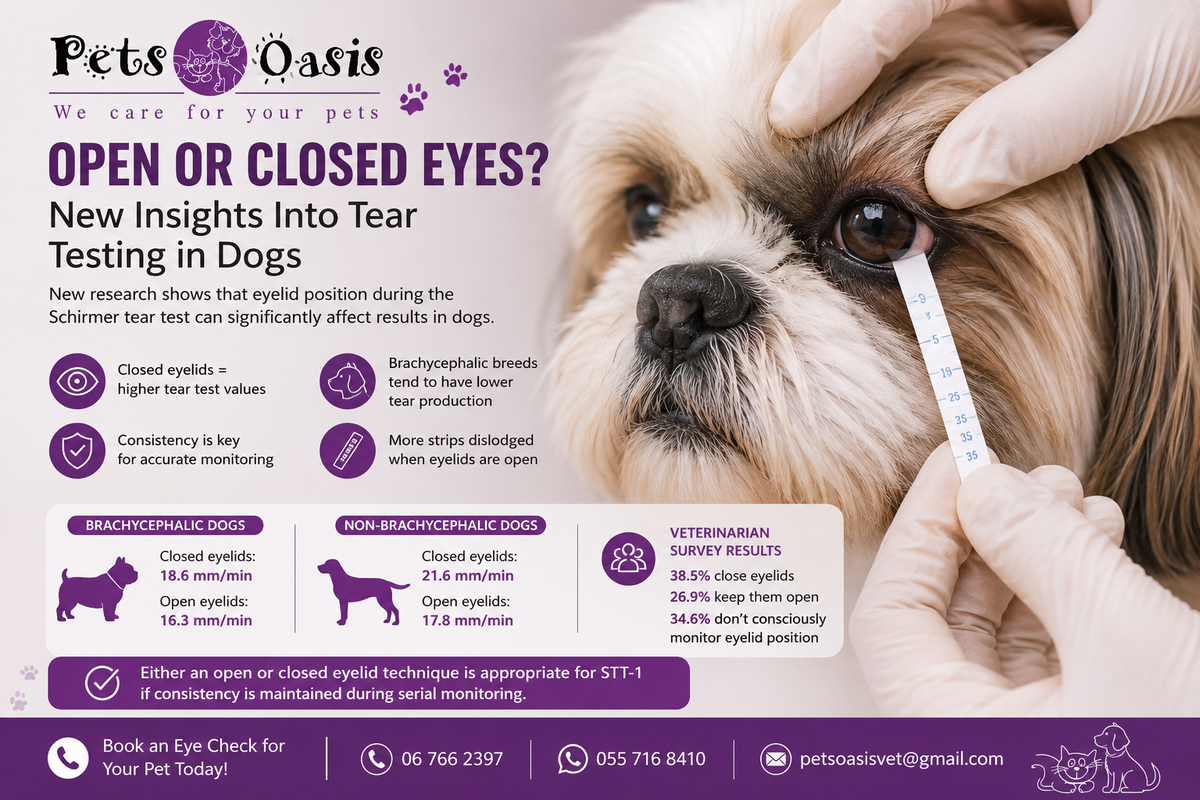
Dry eye disease, or keratoconjunctivitis sicca (KCS), remains one of the most common ophthalmic conditions seen in dogs. Left untreated, it can lead to chronic discomfort, corneal damage, recurrent infections, and impaired vision. For veterinarians, the Schirmer tear test-1 (STT-1) continues to be one of the most valuable tools for assessing tear production and monitoring ocular health.
But a recently published study in Veterinary Ophthalmology raises an interesting and clinically relevant question:
Does eyelid position during the Schirmer tear test affect the results?
The answer, according to new evidence, is yes.
Understanding the Schirmer Tear Test
The Schirmer tear test measures aqueous tear production by placing a standardized strip of filter paper inside the lower conjunctival fornix for one minute. The amount of wetting on the strip helps veterinarians assess whether a dog is producing adequate tears.
Because dry eye can be progressive and lifelong, consistency in testing technique is critical especially when monitoring patients over time.
Many factors are already known to influence STT-1 results, including:
- Time of day
- Environmental humidity
- Medications
- Stress and patient temperament
- Strip manufacturer
- Breed-specific anatomy
Until now, however, the role of eyelid position during testing had not been clearly evaluated in dogs.
What the Study Investigated
In this 2024 study by Pe’er, Ofri, and Sebbag, researchers evaluated healthy brachycephalic and nonbrachycephalic dogs undergoing STT-1 under two different conditions:
- Eyelids manually held closed during testing
- Normal blinking allowed with eyelids open
The study included:
- 15 Shih Tzus (brachycephalic dogs)
- 15 Labrador Retrievers (nonbrachycephalic dogs)
Each dog underwent both testing methods in a randomized fashion, with measurements recorded at 10-second intervals over one minute.
Researchers also surveyed members of the veterinary ophthalmology community regarding how they routinely perform STT-1 in clinical practice.
Key Findings From the Research
The findings were clinically significant.
Dogs tested with manually closed eyelids consistently showed higher STT-1 values compared with dogs tested with open eyelids.
Average Tear Test Results
Brachycephalic Dogs
- Closed eyelids: 18.6 ± 2.7 mm/minute
- Open eyelids: 16.3 ± 2.5 mm/minute
Nonbrachycephalic Dogs
- Closed eyelids: 21.6 ± 2.9 mm/minute
- Open eyelids: 17.8 ± 3.2 mm/minute
This suggests that simply changing eyelid position during testing may create clinically meaningful differences in measured tear production.
Why This Matters in Practice
In veterinary medicine, trends matter just as much as individual numbers.
A dog being monitored for dry eye disease may appear stable or improved if testing technique changes between visits — even when tear production itself has not truly changed.
The study authors therefore recommend that veterinarians maintain a consistent technique during serial monitoring, whether using open or closed eyelids.
Consistency helps ensure:
- More reliable interpretation of trends
- Better treatment decisions
- Improved long-term management of chronic dry eye disease
The Unique Challenges in Brachycephalic Dogs
The study also reaffirmed an important clinical observation:
Brachycephalic breeds tend to produce lower aqueous tear volumes.
This is especially relevant for breeds commonly seen in companion animal practice, including:
- Shih Tzus
- Pugs
- Bulldogs
- Pekingese
- Boston Terriers
These breeds already face increased ophthalmic risks due to their facial anatomy, including:
- Corneal exposure
- Lagophthalmos
- Reduced blink efficiency
- Tear film instability
At veterinary clinics across Dubai and the UAE, brachycephalic dogs are increasingly popular family companions, making proactive ophthalmic care especially important.
An Additional Practical Observation
Another useful finding from the study involved strip displacement.
When dogs were tested with open eyelids, Schirmer tear strips prematurely dislodged in six dogs. No strips became dislodged during closed-eyelid testing.
For clinicians, this highlights a practical benefit of manual eyelid closure, particularly in active or anxious patients.
What Veterinarians Are Currently Doing
The survey portion of the study revealed notable variation among veterinary ophthalmologists:
- 38.5% manually close the eyelids
- 26.9% leave the eyelids open
- 34.6% do not consciously monitor eyelid position
This variation reflects the reality of clinical practice: multiple techniques may be acceptable as long as they are applied consistently.
What Pet Owners Should Know
For pet parents, this study is a reminder that veterinary diagnostics are nuanced. Small procedural differences can sometimes influence results, particularly in ophthalmology.
If your dog has chronic eye discharge, redness, squinting, recurrent infections, or dry eye disease, regular monitoring with a veterinarian is essential.
At Pets Oasis Veterinary Clinic, we emphasize individualized ophthalmic care, especially for breeds predisposed to ocular disease. Consistent diagnostic techniques, careful monitoring, and early intervention all contribute to preserving long-term eye comfort and vision.
Final Thoughts
This study offers a valuable refinement to a routine diagnostic test that veterinarians perform every day.
The key message is not necessarily that one technique is superior to the other, but rather that consistency matters.
Whether performing STT-1 with open or closed eyelids, maintaining the same approach during serial evaluations can improve reliability and support better clinical decision-making — particularly in dogs with chronic ocular disease.
As veterinary medicine continues to evolve, even small procedural insights like these can help improve patient care in meaningful ways.
FAQs
What is the Schirmer tear test in dogs?
The Schirmer tear test measures tear production in dogs and is commonly used to diagnose dry eye disease (keratoconjunctivitis sicca).
Why do brachycephalic dogs have more eye problems?
Flat-faced breeds often have prominent eyes, incomplete blinking, and tear film instability, increasing their risk of ocular disease.
Can eyelid position affect tear test results?
Yes. This study found that manually closing the eyelids during testing produced higher tear measurements compared with open eyelids.
Is one Schirmer tear test technique better than the other?
The study suggests both techniques are acceptable if used consistently during monitoring.
What are signs of dry eye in dogs?
Common signs include redness, thick discharge, squinting, pawing at the eyes, and recurrent eye infections.